
When people first hear about a miniature city like Mini-Munich, a temporary city run by children with its own currency, jobs, and government, they tend to picture an insular world: streets, storefronts, and institutions that function together, but with no connection to the larger city outside.
Some miniature cities are exactly that. But for a miniature city to retain its attractiveness over time, it has to interact with the world around it. And not just through field trips, but as a routine feature of civic and economic life. The question is how.
Bringing the city in
The simplest way to do that is by invitation. The city council of a miniature city can invite their counterparts from the actual municipal government. Not to give a speech to a forcibly assembled audience of children, which is the school model, but to attend a city council session as guests, answer questions from councillors who are ten years old, and discover that the questions are unexpectedly precise. The mayor visits — and is received by a mayor. All these encounters can happen on something closer to equal footing than either side expects.
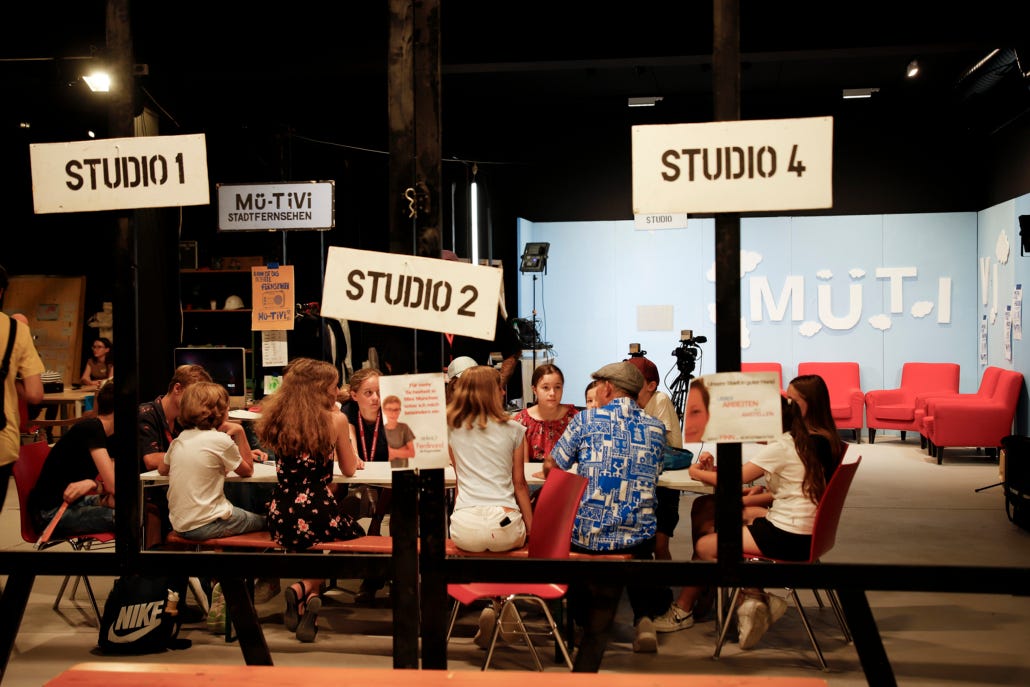
The same logic applies across institutions. The miniature newspaper invites a journalist from the local newspaper to sit in the editorial office for an afternoon, not to lecture on journalism but to work alongside the children. The theatre invites an actor — not necessarily a famous one, though fame helps — to perform or to direct a short piece with the ensemble that has been rehearsing all week. The architecture studio invites a practicing architect to judge a design competition. A moderator from the city’s television station co-hosts the evening news broadcast with the thirteen-year-old anchor.
Some of the most memorable moments involve physical spectacle. A fire engine arrives in the miniature city. Firefighters show their equipment, explain what they do, let children handle the hose. A patrol car pulls up. An ambulance.
Sending the city out
Traffic flows the other direction too. A reporting team from the newspaper goes out into the real city to cover a story: a new restaurant opening, a film screening, a local election. They return with material that is edited and then published in the newspaper. The television crew films an interview at a nearby park and broadcasts it that evening. Children working in the architecture studio visit a building under construction and come back with new ideas for their own work.
These excursions are not field trips in the school sense, organized by adults for educational enrichment. Children go out because the newspaper needs content or the architecture studio needs reference material. The child who visits a bakery does so because she might work in the miniature city’s kitchen and wants to understand how sourdough is scored before baking. The motive is professional, even if the profession is temporary and the professional is eleven.
When the boundary becomes porous
All of this — inviting guests, sending out reporters — is possible even in a miniature city that runs for only a few days or weeks. But something more interesting happens when the city operates over a longer period: months rather than weeks, or even, in the most ambitious version, permanently.
The difficulty with any long-running miniature city is that its internal workings eventually become predictable. Writing the city newspaper is absorbing for a week or two. So is working in the bakery, the architecture studio, the workshops. A child can switch jobs, and most do, but by week four or five the city itself has been explored. The institutions are familiar, the customer requests are the same, the jobs have been mastered. Mastery without new challenge becomes monotony.
The natural solution is to make the boundary between the miniature city and the adult world deliberately porous. The newspaper, initially written for the city itself, gradually expands its coverage and readership into the surrounding town — adults now pay real money for it. A bakery that once fed only the miniature city’s inhabitants starts selling bread to parents who come to pick up their children and discover that the sourdough is actually good. A design studio takes commissions from local businesses. A carpentry workshop builds bookshelves for paying customers.
For the children of such a city, the miniature city eventually becomes a base rather than a destination — a place where materials, equipment, and expertise are available, and where colleagues and deadlines hold you accountable. From that base, children go out into the adult world: to report, to deliver, to sell, to learn.
The university without walls
The academic dimension follows the same pattern. A lecture hall open throughout the day, not compulsory, not graded, where anyone who knows something can speak about it. An invited plumber from town explains pipe fitting. A biologist talks about the frogs in the nearby pond. A twelve-year-old who discovered Fermi estimates gives a lecture on how to estimate the number of piano tuners in Munich.
Children attend when something interests them, skip when it does not, and often show up because something in their work has raised a question. A child in a workshop, commissioned to build a two-metre-tall Trojan horse for the theatre, gets curious about who the Greeks and Trojans actually were. A child who wants to participate in the stock exchange sits in on a talk about percentages and compound interest. The distinction between teacher and student is determined not by age but by who currently knows more about the subject at hand.
The point
A common critique of miniature cities is that they are, in the end, just elaborate pretending: an insular world whose resemblance to real life is only aesthetic, without any of the underlying logic. That they are keeping children away from real life rather than bringing them closer to it. And for a place like KidZania, where children rotate through scripted roles with no connection to one another or to anything outside, the critique is fair.
But a miniature city whose boundary to the adult world is deliberately porous is something different. It brings real life closer. The city acts as scaffolding. Children first do work in the miniature city for the miniature city: writing for a readership of other children, baking for the other children, building the scenery of the theatre in the workshops. As they grow more competent and ambitious, the work extends outward: the newspaper reaches adult readers, the bakery serves parents, the commissions come from local firms. The structure supports them until they no longer need it and decide it’s time to set up their own shop.
Without that porosity, a miniature city is destined to remain a summer program: absorbing for a few weeks, then outgrown. With it, the miniature city becomes something that can run permanently.