Reinhard Kahl, a renowned journalist and filmmaker, made a documentary about Mini-Munich and what makes this temporary miniature city such a remarkable place of learning. The article that follows is his written account of that experience and appears here in English for the first time. Translated by Daniel Fetz with the kind permission of Reinhard Kahl.
With approximately 1,500 children, we wait in the morning outside the Zenith halls in Munich to be let in. By midday, nearly 2,500 children will be counted. Over the next three weeks, I want to observe with my camera team what the children do in Mini-Munich, how they do it, and what unfolds within them and between them, as well as between them and the adults.
The children stand patiently in line. On this first day of the holidays, the sun is shining. Wonderful August sunshine. Some have come accompanied by mothers or fathers. Many sit on the ground, deliberating about what they want to participate in. “Should I become a full citizen?” “Should I go straight to work or study first?” They fill out their Mini-Munich pass or read the rules. Rule number 10 states: “Whoever makes rules can also change them.” That is the job of the citizens’ assembly. There are already many rules and traditions, because Mini-Munich is taking place this summer of 2016 for the 18th time. Every two years, during the long school holidays. Some parents were themselves children here. Many of the supervisors at the construction yard, in the radio studio, or at the inn “The Fat Pig” are former participants.
It will be almost another hour until the doors open. Then the children will come storming in much the way they rushed out of school on the last day of term.
Quite a few have been here two or four years ago, or even more often. You must be seven years old and no older than fifteen. We hear from some that they persuaded their parents to go on holiday later so they could first come to Mini-Munich. And now they want to spend the first days of the holidays, or all three weeks, here from morning to evening, making things, going to the town hall, earning money, shopping whatever gets produced. There is a currency, the MiMü. And they manage their entire daily lives themselves. Parents are only admitted for half an hour, and that, as one already hears, is strictly enforced, with great enthusiasm and joy, by the children themselves. No school, no parents.
Mini-Munich has such an overwhelmingly good reputation among children that one simply has to take a closer look. We have already filmed a preparation day and will now be present every minute until the end of the three weeks. One thing is already clear: if you want to know what joyful anticipation looks like, you need to look at these faces right now.
I am still undecided whether the film will be more of a visionary look at the future of education, or a study of the self-evident. What should be self-evident has become anything but. There are alarming signs that children’s free play is as endangered as some natural habitats.
A glance to the side, before we look around inside the halls and on the open spaces outside. Perhaps it is a glimpse into a future that awaits us, or rather, one that we should prevent!
From the United States of America come reports that are hard to believe. For example, that in Californian parks the lower branches of trees are being sawn off so that children cannot climb them. The justification is liability and insurance. But above all, there is the fear that something could happen. Yes, of course something could happen if children climb trees. But what happens when nothing is allowed to happen?
Of all people, an economist, Nobel laureate Edmund Phelps from New York, fears that the American safety obsession, which is driving vitality out of schools and perhaps even more so out of family life, is not only weakening the creativity of children but stifling the inventive spirit of future adults. This, he argues, is leading to economic decline, and not just in the future. Phelps has already measured the stagnation in inventions and new ventures.
What happened there? The story of 14-year-old Ahmed Mohamed in Irving, Texas caused a stir. He was taken out of school by the police and brought to the station in handcuffs. The son of a Sudanese immigrant had built a clock and proudly brought it to school. The clock ticked and the teacher heard a time bomb.
The story of the Meitiv couple from Silver Spring in the suburbs of Washington also made its way through the media. They had let their six and ten year old children out onto the street unsupervised. Twice the children were stopped by police, most recently in a park. A resident had called the police after seeing the children for some time without adults. Proceedings were initiated against the parents on suspicion of neglect, as the Washington Post reported. All they wanted was for their children to have their own experiences. They were not thinking about violent crime or anything else that could happen.
Geography professor Roger Hart mapped children’s everyday movements in a small town in Vermont in 1972 and returned 32 years later. The range of children had shrunk enormously in that time. They rarely leave their parents’ houses and gardens anymore. Just as the experience of space has changed, so has the structure of time. Parents pick children up from school and schedule appointments for them with average time slots of one and a half to two hours. Then comes the next appointment. Gone are the small jobs in the neighborhood and errands. Nothing more on their own initiative. No scraped knees, no chalk drawings on the ground, no “Ready or not, here I come!”
Further research was carried out by Kyung Hee Kim. She speaks of a creativity crisis and notes a decline in children’s intelligence. The ability of children to produce “unique and unusual ideas” has been diminishing since 1990. Children are less energetic, less talkative, less humorous and less imaginative. They take less pleasure in connecting apparently irrelevant things and arriving at something new. For some time now these findings have been causing a scandal in the US. In Hanna Rosin’s book “The Overprotected Kid” many now read what they could see every day if they watched children. They spend more and more time with adults, talk like them and think like them: “But they are not developing the self-confidence to be independent and self-reliant.” For that they need above all other children. And security that comes from belonging. Security that comes from having weathered adventures and risks. Security that comes from being trusted.
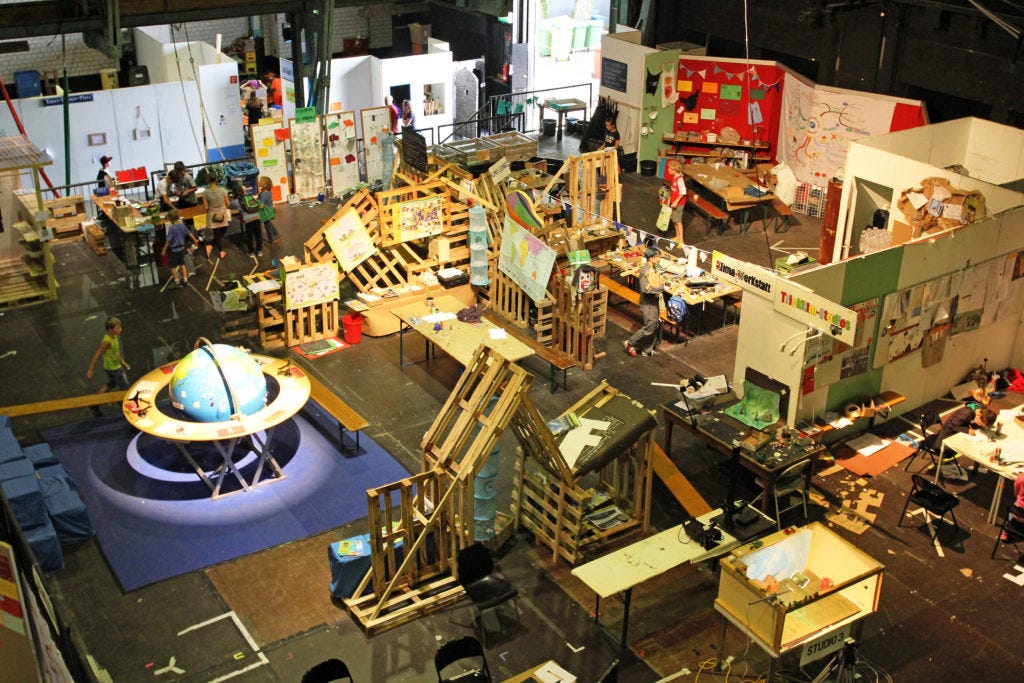
Now we’re off. Ten o’clock sharp. The hall gates open. The children run. Some race to destinations they already know. There is the town hall and the craft workshops, the inn, the Comenius University and the bank and the employment office, also the garbage collection, theatre, cinema and TV station. 68 institutions. The children are mayors and taxi drivers, gardeners and university lecturers. There are markets and elections, rubbish collection campaigns and of course festivities. The embassy building is being designed this year by children from India, Japan, and European cities. Mini-Munich has inspired offshoots in those places. Central this year is climate protection, with a recycling yard and a research institute. 200 adults are the mentors: educators, artists, craftspeople, students and scientists, in short: truly grown-up adults, people from whom children learn firsthand about things and skills, that is, about the world they are so hungry for.
They rush into the halls to get to the particularly popular jobs. For example, taxi driver on soap-box-style vehicles. Or repairing taxis. Whoever then wants to work somewhere else hands in their notice, receives a paycheck that is cashed at the bank. The work card for that job goes to the employment office, where the jobs are advertised throughout the day.
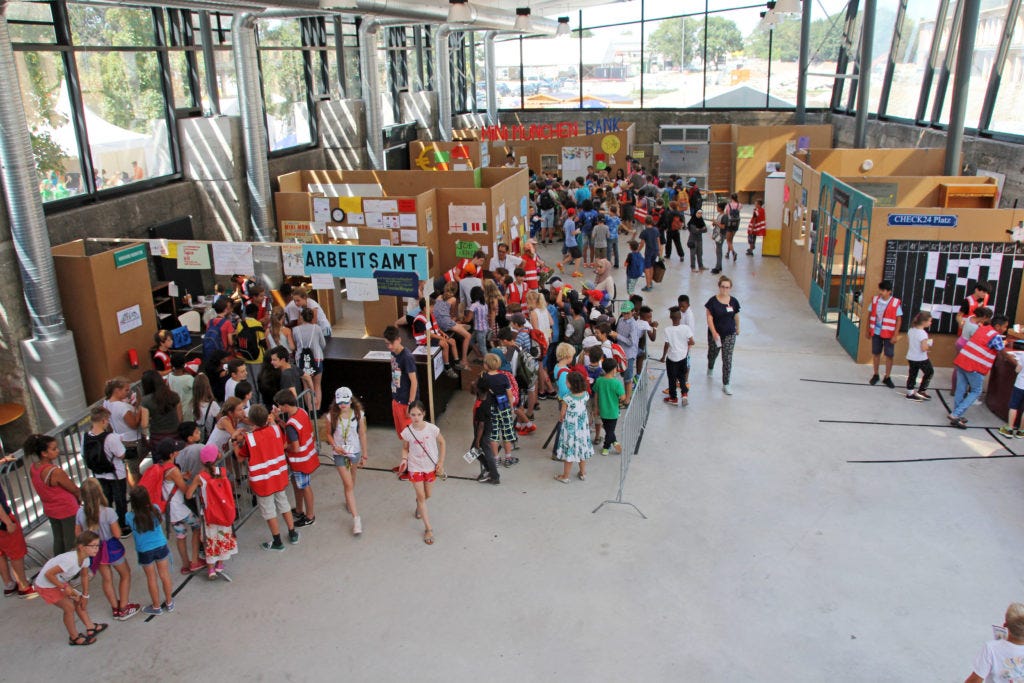
Mini-Munich is both festival and everyday life. Nothing but festivities the whole time would be as hard to bear as nothing but everyday life. The kids come voluntarily. Compulsory fun would be something like a restaurant where you are forced to eat everything on your plate. Even with good food, eating disorders would soon spread.
Many children find their thing. Take one 14-year-old who last time wrote close to a hundred pages of legislation for the children’s republic. Where did he get that from? The children immerse themselves in topics. This time some have developed digital payment transactions, which they are introducing alongside the printed MiMü currency. Expert stuff. Children switch between their occupations. This is partly because they are looking for something they can get hooked on. But they do not switch constantly to the 45-minute rhythm of the timetable, as if the morning were a pro-ADHD training session.
Another glance to the side. In an age when pupils, and increasingly students too, are talking about binge-learning, it becomes important to look at environments where learning and doing are intertwined.
What does it mean to get hooked on something? How does that work? What would knowledge be without the driving force and without the fascination of the unknown? What would remain for curiosity and for the joy of learning, creating and transforming in a world that is already complete? And what happens when school and everyday life are so barren that kids rarely find anything to get hooked on, when there is no space for transformation because they are expected to just function, and then after many years of school do not know what they want?
That is the theme behind the theme of this already so lively and colourful event: how do children become fully alert and wholly present in an environment of exploration and doing? Which microstructures of learning, doing and enthusiasm can be observed there? We want to make these visible in the film. How do moments of hesitation and intensity alternate when unresolved questions give way to solutions? What happens with children when something truly significant is at stake for them? What rhythms of time and what kinds of choreography develop in tasks and in free cooperation? What role do the lecturers, experts and artists, that is the adults, play?
At the Comenius University, Ellen Fritsche teaches. She is a fan of Mini-Munich. Has been for years. She donates and is a “professor” there. Professors are those who give lectures or hold courses. Children, teenagers, professionals or someone like Ellen Fritsche do this. She is 88 years old and, without exaggeration, belongs in many respects among the youngest. She has been interested her entire life, since 1945 to be precise, in hands. She is also interested in much else. But when it comes to hands, her knowledge is enormous. And hands have remained for her an at least equally great mystery. She is not finished with hands. She has plenty to say about hands. Her enthusiasm and curiosity have not waned.
“We have 17,000 touch receptors in our hands.” The children are astonished. “But of course nobody can imagine that,” she adds straight away. That is why she has cut out small pieces of paper, one square centimetre in size, and handed them out to the children. “On one centimetre of fingertip there are 144 receptors.” That is easier to picture and therefore also to remember. Mrs Fritsche is a good teacher, though teaching was never her profession. She had founded a glove manufacturer.
Her hands are constantly in motion. She speaks not only about hands, she also speaks with them, explains what we use them for and what they express. In the womb this game already begins and for the baby the fingers are then the first toy. How wonderful that in this organ, activity and perception lie so close together. What would we be without hands? “You must try to imagine this,” she demands. Pause. Concentration and quiet. Alert, contemplative faces, and beautiful ones at that. Then she asks the children to feel their own pulse. “What, you feel nothing?” she asks in a powerful voice. “That is terrible, then you are dead.” But of course nobody here is dead. Nor appearing dead while alive, as children so often seem to in ordinary lessons. Ellen Fritsche is simply infectiously energising. She is reminiscent of Albert Einstein’s answer to the question of how he was able to figure out and discover so much. He said: because I have always remained the eternal child. Of course it is absolutely clear with Albert Einstein and with Ellen Fritsche that this eternal child has nothing to do with childishness. On the contrary. Successful adults, unlike the many who have grown confused, have not only developed their judgment, they offer this eternal child protection. They have not suppressed it. So they remain forever capable of being freshly wondering, great beginners. The more they know, the more questions they have. They are simply not finished. That is what makes an Ellen Fritsche or an Einstein so kindred with children. Children sense this kinship immediately. Children need such adults.
We are now a few days in. One morning around nine, on the way from the underground station to the Zenith halls, three children are jogging ahead of me, that childlike enthusiasm in their step. One glances at the time and says “there are still exactly 57 minutes, we can dawdle a bit more.” They slow their pace. The second, “no, the queues are always so long.” The third, “then let’s run.” The first again, “that way we save at most half a minute.” Then they are off again in that happy jog. Joyful anticipation in motion. Anticipation of the day, anticipation of experiences and anticipation of themselves.
Our first stop this time is the garden centre. The children carry baskets with plants out into the open, water them, explain to us which ones need the watering can with its spout, the young seedlings that is, and which ones are watered without it but with a gentle stream. Such proud expertise. At the construction yard, Little-Mini-Munich is taking shape. Here the children build houses, at first stalls, then more complex constructions. A carpenter is always on hand. A U-boat model is also being worked on. The stop-motion filmmakers need it. In the kitchen, potatoes are being mashed. Butter, quark and plenty of chives are added. It becomes a bread spread. The waiters try on their floor-length red aprons, take notepads and will later take orders, serve and take payment.
What is remarkable is the dedication of the children. Everyone finds their place, stays for a few hours, then moves on if they want to. Most of those in the kitchen want to stay there. Others also want a turn in the kitchen. Perhaps a topic for the citizens' assembly in the afternoon? However only full citizens can vote there. Full citizenship can be applied for after four hours of work, four hours of study and a “dispute resolution course.” There one learns not to let arguments escalate.
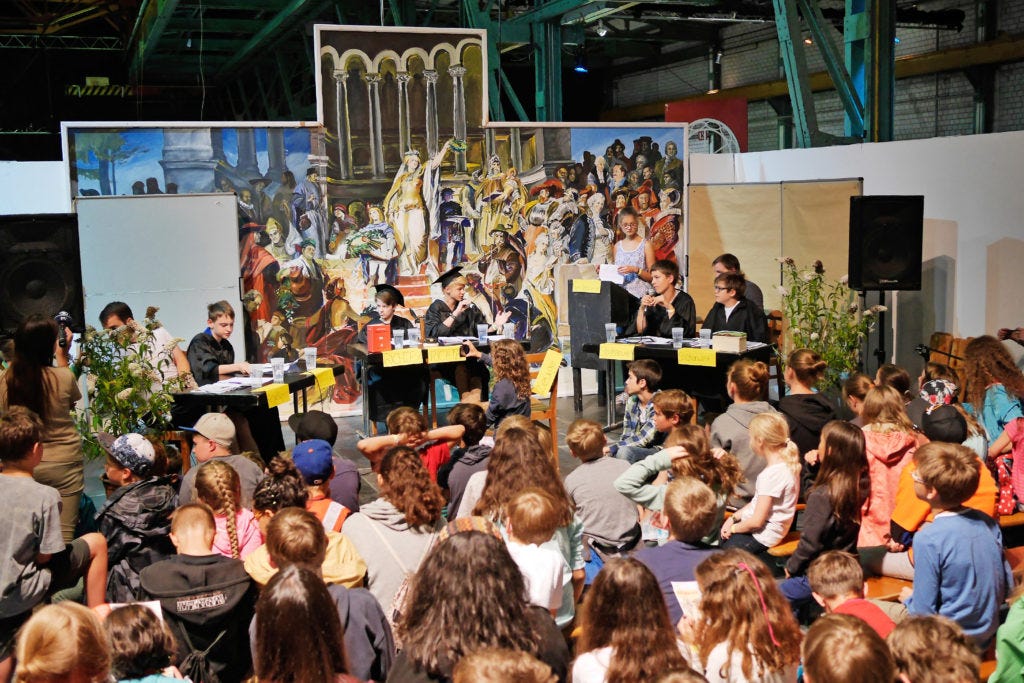
The constant: the children are present. They are truly there, with body and soul. In the fullest sense of that phrase. The sensitive body that thinks along with us is after all something other than the merely physical body. The children are not caught up in the frantic state of always doing one thing only to get to the next that is common in school and increasingly dominates society. That eternal treadmill on which one never truly arrives. Perhaps that is the strong gravitational pull of Mini-Munich: to do something consequential! To be needed in this cosmos! To find one’s place! The chance to simply be fully present! To find one’s thing, for a while, and then to keep searching and trying!
The beautiful thing, perhaps the most beautiful thing about Mini-Munich, is that the children have time. And the adults too. Most schools are contaminated by the fact that children and teenagers have no time and teachers none at all. The frequent boredom there does not contradict this diagnosis. Whoever is bored has lost touch with the world. That happens. One emerges from this deficiency when, from this zero point, one finds new facets of the world, perhaps even invents some. But boredom in school is not of that kind. It is the boredom of being unconnected, without the chance to form new bonds there, except those in the currency of school, the “subject matter.” But that is not the world.
Let us leave school aside, though of course when looking at Mini-Munich the comparison with it inevitably comes along. As an unbiased ethnologist from another continent one might perhaps find nothing particularly special about Mini-Munich. It would be a perfectly natural way of introducing children to life. One could consider Mini-Munich entirely self-evident, if in our surroundings it were not so scandalously far from self-evident. For that reason alone, the background hum of everyday school life, and of the years of life shaped by it, cannot simply be tuned out.
Adults in Mini-Munich often speak of the children being in a state of flow. What is this flow state? Complete absorption in an activity. Researchers like Mihály Csíkszentmihályi emphasise that task and problem-solving ability must be in balance. It is not about everything. It is about a clearly defined area. It is also not about me, for example about whether I am better or worse than someone else. It is about a field of action. And there is clear feedback. The activity is its own reward. Praise from outside has no or only minor significance.
The sociologist Richard Sennett has captured this in his great book on craftsmanship: “To do something for its own sake and to want to do it well.” For that there is little room and no time in the usual world where everything is a means to an end. Whatever is done there never quite suffices. In such a world, everything becomes a means or is put to use. And whatever is merely put to use is ultimately devalued. That is why children and adults alike so quickly become overwhelmed, sink into exhaustion, and complain in unison that they have no time.
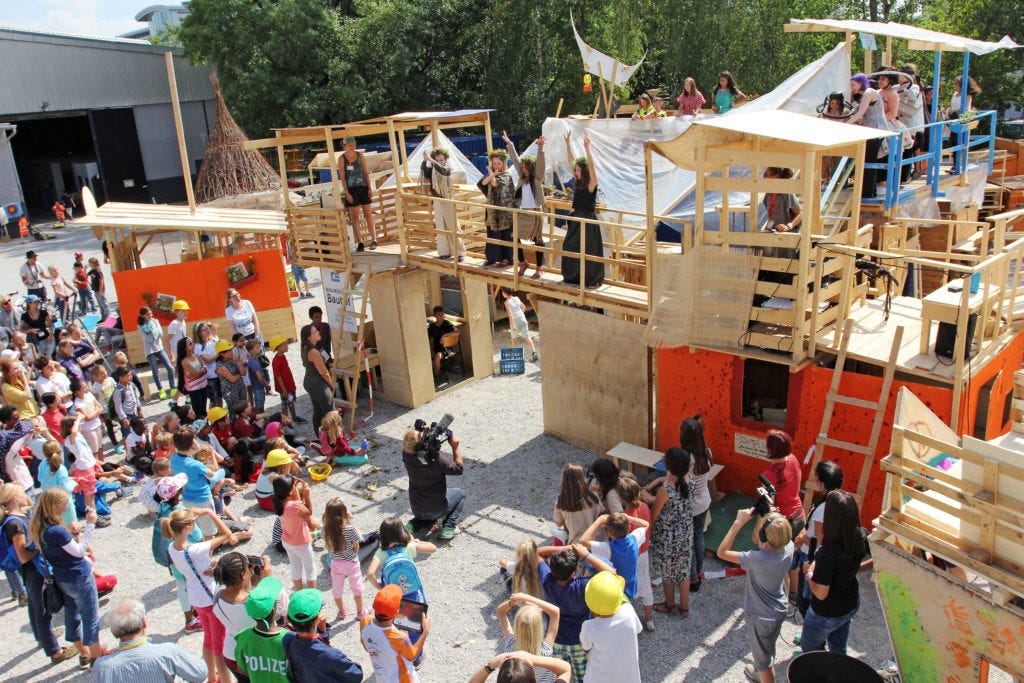
With that we are back in the middle of Mini-Munich and among the children. We continually see children who are deeply absorbed in something. In the architecture studio, for example. Only moments ago they were outside measuring the plots on which houses are to be built. They were alert and agile. Now they are bent over paper transferring measurements, building scale models. A cupboard could fall over next to them and they would not even flinch. Neither the village square bustle nor a cameraman moving in close makes them look up. Maria Montessori called this the polarisation of attention.
The secret of Mini-Munich is that the things, the activities and the goals are themselves important and valuable. That is why many children do not want to go home at five o’clock, and come back the next morning to queue by the hundreds long before opening time.
Time at Mini-Munich passes quickly. Most striking is the attitude of the children. Their seemingly unbelievable attentiveness. Their intensity. Contrast this with school, where pupils mostly just sit, reduced to carrying a head around and being told to keep still, while here the children move freely and work together harmoniously, in an environment that calls on both body and mind. Not once did I hear the command “Quiet!” that week. Nor were any disciplinary problems noticeable. The children are not here merely to absorb and store information for later use. They are fully present. They are in the world. It is not handed to them second-hand. It is experienced through doing. Some former participants who met one afternoon noted that they had not seen a single child with a smartphone in their hand.
Mini-Munich is a laboratory of learning, thinking and doing and deserves to be understood as such. Because the children want to do things, they think, and in doing so they learn. Many, even in Munich, still think of this as a very lovely and rather elaborate holiday childcare provision. This is not childcare! Mini-Munich relates to school not as leisure relates to work, but more as the grammar of industrial society relates to that of a post-industrial society built around human activity. And that society is being shaped right here, which is what is so remarkable. One gets an idea of what a school could look like. One made of workshops, studios, practice rooms, also cafés and rooms of stillness. In such a school teachers would also be those who gather interesting people. They bring in experts, masters of their craft, ambassadors from the world of meaningful work, and lead the children out to interesting places. The school itself would be a base camp of society, a generative place where generations come together and create something new. How important the vitality and curiosity of children is for us adults! It would be a give and take.
The children encounter things, phenomena themselves. That is why they are so enthusiastic. They transform things. They call that work. And learning is taking things, experiences and knowledge and making them truly one's own. In the process, after only a few days, they have grown a head taller. I have heard this sentence many times, including from a journalist at the Bavarian Radio. She makes a daily radio programme “radioMikro” here with the children and brought along her son who is in first grade. At school, she says, he began more and more to get bored and was frustrated because he could no longer move freely as in kindergarten and do his own things. Here he is happy, busy, not bored, and after a few days he has “grown a head taller.”
And what comes out of it when children do their things, find their thing and keep pushing it further and further? The journalist herself was at Mini-Munich for the first time as an eight-year-old. There she first wanted to do nothing other than work in the kitchen “The Fat Pig.” “Just stirring the whole time.” In the following years other things were added. Finding one’s thing is not a linear or one-time affair. One would actually need to invent a new concept for it: positive traumatisation. Or simply: happiness.
Happiness? On the last day of Mini-Munich, Ellen Fritsche, the 88-year-old professor at the Comenius University, stood up from her cardboard stool. Earlier she had marched along in the closing parade of all the trades: a surreal parade that seemed as though it would never end, with for example the bicycle kitchen that had welded old bicycles into new ones, and the various groups from the recycling yard and research institute, and on and on. Here again, the most important and most beautiful thing was the faces of the children. Ellen Fritsche sits back down on her stool and leans against the wall of the hall. Next to her stands a cook, looking astonished. Not a cook from the “Fat Pig”, but from the kitchen for the 200 staff members. “Such a thing,” says the cook, “I have never seen. Such happiness!” And then Ellen Fritsche stands up and says in front of a rolling camera: “On the subject of happiness I want to say something to you. I had my car in the garage, but they were having trouble getting the spare part in time. But how, I said, should I then give my talk at Mini-Munich?” She takes a breath and swallows, as if holding back tears. “Then the garage owner came and said, what, Mini-Munich? My children were so happy there. Take my car and just go.”