
A response to David Deutsch’s “Are schools inherently coercive?” (Taking Children Seriously 25, 1998)
In 1998, David Deutsch argued that no school can be non-coercive. By “school” he meant an institution that concentrates learning resources and opportunities in one place, and that most children would voluntarily turn to for several hours on most days during most of their childhoods. The core of the argument was that children’s interests are too diverse, too personal, and too sporadic for any single institution to hold their voluntary attention long enough to meet that bar. The only existing institution that comes close, he concluded, is “the entire town (or city, or society, or internet) that the children have access to, including their homes, and their friends’ homes, and excluding only the existing schools.”
I think Deutsch is right to be skeptical that schools can be non-coercive. He is also right to highlight the importance of an environment diverse enough to attract children’s voluntary engagement. But his argument stops one step too early. Diversity is not enough. What matters just as much is whether children can participate in the world around them, and in real towns much of that world remains closed to them. But there is an institution, already existing in embryonic form, that points toward a solution: the miniature city.
Access Is Not Participation
Deutsch’s argument proceeds by analogy. Rather than imagining existing schools with all the coercion removed, he asks us to begin with institutions that already attract children voluntarily. Imagine, he says, trying to modify a cinema so that most children spend most of their time there voluntarily. You would need to raise attendance from perhaps 30 percent of a town’s children for two hours a week to 90 percent for 30 hours. But Hollywood is already doing its best to make films attractive, and even that is nowhere near enough. Expand the analogy to a mall with an ice rink, bookshops, burger bars, and the same logic holds. Even a child who likes the mall’s ice rink may prefer to play tennis or football elsewhere, visit a better bookshop in town, go to an exciting pizza place, or simply stay in their room to work on a project of their own. A mall still cannot outshine the town as a whole in diversity and personal relevance. If it could, it would. Therefore, the only non-coercive school is the entire town.
The argument is compelling, as far as it goes. But it contains a hidden assumption: that access to a town means meaningful participation in it. For adults, this is broadly true. For children, it is not.
A ten-year-old boy may have some access to the town. He can walk its streets, browse its shops, and eat its food. But he cannot work in its bakery. He cannot run for its city council. He cannot meaningfully start a business, write for its newspaper, or apprentice himself to most trades. This is not to say that children never participate in the more serious realities of life. Older children and adolescents may babysit, help in family businesses, do odd jobs, or take on small informal responsibilities. But these forms of participation are usually marginal, exceptional, or tightly limited, not open entry into the central economic and civic life of the town. As the educational thinker Horst Rumpf observed, the history of childhood over the last two hundred years is, in large part, a history of exclusion from adult life.
This matters because of the epistemology that underlies Deutsch’s argument. Karl Popper argued that knowledge grows through conjecture and criticism, not by having information poured in from outside, but by the mind actively generating theories, testing them against reality, and revising them when they fail.
For this process to work, two things are necessary, and they are distinct but connected:
First, the learner must be free to form their own conjectures, to choose what to try, what to care about, what to explore. This is the freedom Deutsch rightly argues schools cannot provide: the curriculum largely determines which conjectures the child is permitted to pursue.
Second, there must be genuine feedback from reality. The conjectures must actually be tested against reality, not against an authority’s judgment of them. When feedback comes from a grade or a red mark, several things go wrong at once: the child learns to correct their theories relative to what the authority thinks rather than relative to whether the idea actually works; the implicit question shifts from Does this work? to Does this satisfy the authority?; and over time, children learn which conjectures are permitted rather than developing the capacity to generate and test their own. A child who goes out underdressed and freezes learns something from the cold itself. This feedback is unmediated, inarguable, and impossible to game. A grade is none of these things. It is one person’s fallible theory about the work, delivered as verdict.
Schools typically fail on both conditions. Real towns do much better on the first, but for children they often fail on the second. Not because natural feedback is absent in towns. It is abundant. The problem is that children are structurally excluded from many of the activities that generate it. And when participation is closed off in this way, freedom of conjecture is narrowed in practice as well. A child may be free to wonder whether they would be good at running a bakery, writing for a newspaper, or taking part in policy-making, but if no one will let them try, those conjectures cannot be meaningfully pursued.
Rumpf captures the contradiction well: children are locked out of adult life, and yet they are supposed to grow up. How can one prepare someone for something when one systematically excludes them from it? The conventional answer is school: a place set apart from the world, where the world is broken into lessons and poured back into the child as course material. But if Popper and Deutsch are right, this cannot work. The unconventional answer is the town. Yet for children, the town offers freedom without meaningful participation in productive enterprises. It offers the freedom to wander, to observe, and to consume, but not to take part in many of the activities where choices have real consequences. Children are free, but free to do what? To watch others make things, decide policy, and conduct business. That is not, in any rich sense, Popperian education.
The Miniature City
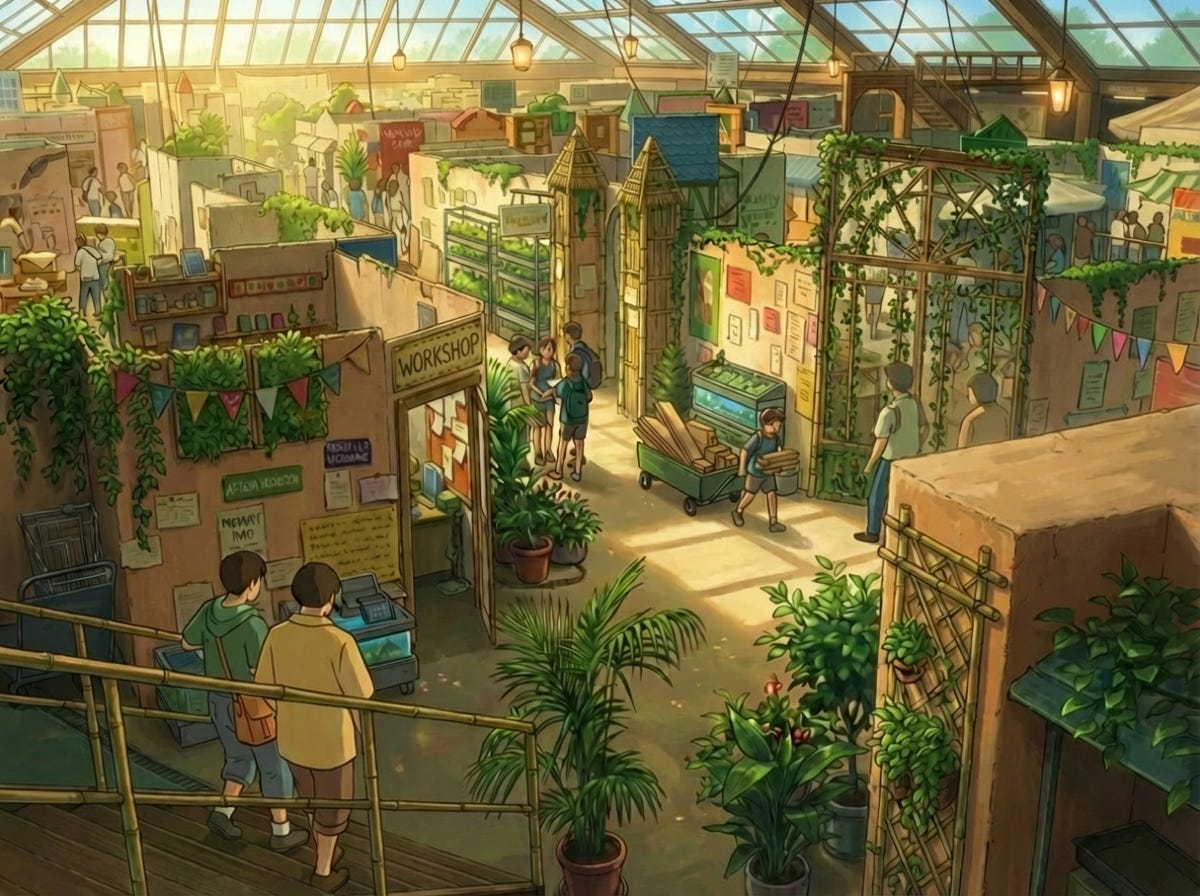
This is where miniature cities enter the picture. They offer children access to forms of participation from which real towns often exclude them. Mini-Munich, which has run in Munich since 1979 as a summer program lasting a few weeks, is the best-known example, and the model has since spread to hundreds of similar projects, primarily in Germany and Austria.
In Mini-Munich, up to 2,500 children per day, aged six to fifteen, run bakeries, publish newspapers, operate radio and television stations, manage banks, sit on city councils, adjudicate disputes, start businesses, and earn and spend a local currency called MiMüs. They can also attend the city’s university, give lectures of their own, and listen to lectures by others. Adults facilitate but do not direct. There is no curriculum, no compulsory attendance, and no exams. A child who wants to leave the bakery to work for the newspaper can do so. A child who wants to sit and do nothing can do that too.
The miniature city also includes workshops, artistic venues, and a full apparatus of civic administration. Children can work in tailoring, glassblowing, gardening, architecture, theatre, cooking, and many other activities, and they can take part in collective governance through a city council, mayoralty, citizens’ assembly, and courts.
What matters is the interdependence of the roles. The city functions as a social order rather than a collection of separate activities. An architecture studio may be asked to design a façade or interior for another enterprise. A marketing agency may be hired to create flyers and advertising material. Advertisement spots can be bought in the newspaper. Decisions in one part of the city create needs, opportunities, and problems in others. Children participate in a world of mutual dependence that responds to what they do.
Reality as Teacher
When a child runs a detective agency in Mini-Munich and does it badly, customers stop coming. This is the internal feedback of a working economy. When a child writes for the newspaper and makes errors, other children complain that they are poorly, incorrectly, or incomprehensibly informed. When a child sits on the city council and proposes a policy, that policy may be debated, adopted, tested in practice, and later revised or abolished based on the outcomes it produced. When something goes wrong in the kitchen, a snail turns up in the salad because it was not washed properly, it is in the newspaper that evening, and three people from the kitchen are in the television studio the next day answering the news anchor’s questions. This actually happened.
As Rumpf, who spent two days observing the city, put it: mistakes are never made visible through red marks and grades, but always through the consequences of actions and the protests and objections of others. This is conjecture and criticism at work within a social fabric that makes error-correction natural rather than punitive.
Consider the contrast with school. In school, a child writes an essay and a teacher grades it. The feedback is authoritative, external, and only loosely connected to whether the writing works for anyone besides the teacher. In Mini-Munich, a child designs an advertising flyer for another enterprise. If the text is confusing, ungrammatical, or hard to understand, the flyer fails in its purpose. Customers do not respond, and the enterprise that commissioned it complains. The feedback is not imposed by authority. It comes from whether the writing actually achieves its objectives.
Or consider politics. In school, children are sometimes permitted to stage political debates in the classroom with assigned roles, but money and power remain outside. In Mini-Munich, children propose laws, debate them in citizens’ assemblies, elect mayors, and live with the consequences. When the children’s city council introduced a police force in 1985, various incidents led the same council to abolish it. When an enterprising group of children set up a stock exchange in collaboration with the bank, it produced MiMü millionaires and a speculative bubble. The point is not just that these decisions have consequences, but that they can be tested. They do not remain matters of classroom discussion alone. They are tried in practice, and in that way become open to criticism, revision, and abandonment if necessary.
What makes this possible is the limited scale of the miniature city. Its institutions are small enough for children’s actions to matter, and clear enough in their workings so that feedback is less buried under noise than it is in adult society, where the effects of decisions are harder to isolate and thus harder to learn from.
The Effective Diversity of a Town
Deutsch’s central point about diversity is worth restating. No single institution, he argues, can match the diversity of the town as a whole. No cinema, no mall, no single building can outshine it in the range of attractions it offers children. Mini-Munich complicates this picture. It is, after all, a single place, and yet it does manage to attract thousands of children voluntarily for most of the time during the three weeks it takes place. In that sense, it appears to come close to satisfying Deutsch’s own criterion for a non-coercive school.
Meanwhile, real towns, despite their enormous diversity, contain vast amounts of activity that children can observe but not meaningfully enter. This is not always because the activities themselves are beyond them. More often, adult institutions are shaped by legal restrictions, economic incentives, and cultural inhibitions that make children’s participation difficult to accommodate. The effective diversity of a town, from a child’s perspective, may therefore be considerably smaller than it appears. A miniature city that concentrates the activities children actually find engaging, and makes them participable rather than merely observable, might for practical purposes approach or even exceed the effective diversity of a real town.
Between 1,000 and 2,500 children show up to Mini-Munich voluntarily each day during the summer. Attendance varies with the weather: on hot days many children prefer to go swimming instead. In that respect, Deutsch’s point still stands. Even a miniature city this attractive does not displace the wider town, or the many other things children may freely choose to do. But it shows that a single institution can become a place children voluntarily choose for most of the day, for weeks at a time, while remaining in open competition with the rest of the world. When funding was threatened in 1985, children organised letters, phone chains, and visits to real politicians to save it, securing a funding commitment of 100,000 DM. They did this on their own initiative, initially without the knowledge of the adult organisers. It is hard to imagine children mobilising in quite this way to defend an ordinary school.
Order Without Direction
A miniature city is designed by adults, and that invites two worries: first, that it is imposed from above, that its structure is fixed in advance by the choices of its adult organizers; second, that even without compulsion it channels children toward some activities rather than others.
The first worry is easy enough to answer. Every human institution is designed by someone. The relevant distinction is not between designed and undesigned environments, but between designing a framework and designing outcomes. Mini-Munich’s currency, citizenship rules, and democratic procedures are designed in the way that a constitution is designed. But what emerges within that framework is not: which businesses children start, which laws they pass, which market bubbles occur, which mayor is elected, which newspaper stories are written, which kitchen scandals erupt on the evening news. Adults create conditions for emergence without dictating what emerges. In that respect, Mini-Munich resembles a functioning liberal society.
The second worry is harder to answer. A miniature city with eighty enterprises is still a curated subset of reality. It does not make every possible pursuit equally available or equally central. The gravitational pull of a rich institutional environment is itself a subtle form of channeling, even without compulsion. By making some conjectures dramatically easier to pursue than others, the city shapes what children try, not through coercion, but through the sheer weight of what is available and what is not.
But the more important question is not whether children are being channeled, but toward what. The miniature city is built around civic and economic participation, around making things, selling things, governing, publishing, and working. The picture of adult life that children typically encounter is badly distorted by comparison. Online, they are exposed to influencers, which selects heavily for visibility over substance. From adults, they are encouraged to become doctors, lawyers, or whatever else carries prestige. And the economy is visible to them only as its outputs: products to consume, services to use, with the actual work of production out of sight. No wonder children have little understanding of the vast texture of economic and civic life that actually keeps a society running. The miniature city’s channeling is part of what makes it valuable. It offers children a more honest picture of what a society actually consists of.
It is true that the miniature city does not mirror the full range of every possible human interest, and it would be dishonest to pretend otherwise. This does not mean, however, that children are limited to a predetermined set of activities. Children who wanted a stock exchange built one. Children who wanted to strike organised one. If a child wants to introduce something that does not yet exist, there is room for it, though it requires their own initiative, just as it would in the real world.
More telling than any official description is the behaviour of the children themselves. They are not performing for adults. They are engaged in activities that matter to them within a system that responds to their actions. Rumpf recounts an eight-year-old garbage collector with his red cap and real wheeled bin, who develops a different awareness of dirt on streets and the problems of street cleaning than even the most vivid school lesson could produce. The children who conduct surveys on the street come to understand polling not through a lesson on survey methodology, but through the experience of asking strangers questions and recording what they say. Imagination, here, becomes the medium through which they come to know the serious adult world.
And yet the city does not become what Rumpf calls infantilised, a fantasy disconnected from reality. The seriousness is maintained by several structural features: the binding economic and citizenship rules; the adult craftspeople whose competence children sense immediately; the real materials and equipment, real glassblowing tools, real stage lights, that demand careful handling; and above all, the public sphere of the city itself, which ceaselessly subjects everything to scrutiny through newspapers, television, and civic debate. If something goes wrong, the city’s own media apparatus ensures it becomes a matter of public discussion. The result is, as Rumpf puts it, enough fun that reality does not become crushing, and enough seriousness that the surplus of fun does not become childish.
What Remains to Be Addressed
Deutsch’s 1998 essay was, in a sense, a conversation-stopper. If the only non-coercive school is an entire town, and towns exclude children from meaningful participation, then we are stuck. The miniature city reopens the conversation. It is not a conventional school, but it is closer than schools usually are to what people have hoped school could be: a place where young people learn, not because they are forced to, but because the world they inhabit responds to them, challenges them, and takes them seriously.
Children’s interests are indeed too diverse and too personal for a curriculum. But they may not be too diverse for a city, even a miniature one, if that city gives children genuine roles, real economic participation, and a say in collective decisions.
The remaining questions are hard. Can the model run year-round, rather than for three summer weeks, while retaining its attractiveness? How does it relate to the real town around it, not as a replacement but as a complement, a bridge between the child’s world and the adult world that Deutsch rightly says should be open to them? These are serious problems. But they are engineering problems, not philosophical impossibilities. They are, in the Popperian spirit, a better set of problems to work on than the ones we had before.
Mini-Munich was not built by philosophers. It was built by a group of cultural pedagogues in Munich who, through decades of trial and error with smaller projects, play cities made of cardboard and beer crates, historical city games, media cities, factory cities, gradually developed the practical knowledge needed to construct something that works. They might not describe what they built in the terms I have used here. But what they built, whether they intended it or not, is a partial answer to one of the deepest questions in the philosophy of education: how to give children the freedom to form their own conjectures and the reality against which to test them, without coercion, without curriculum, and without the condescension of assuming they cannot handle a world that takes them seriously.