What is minicities.org?

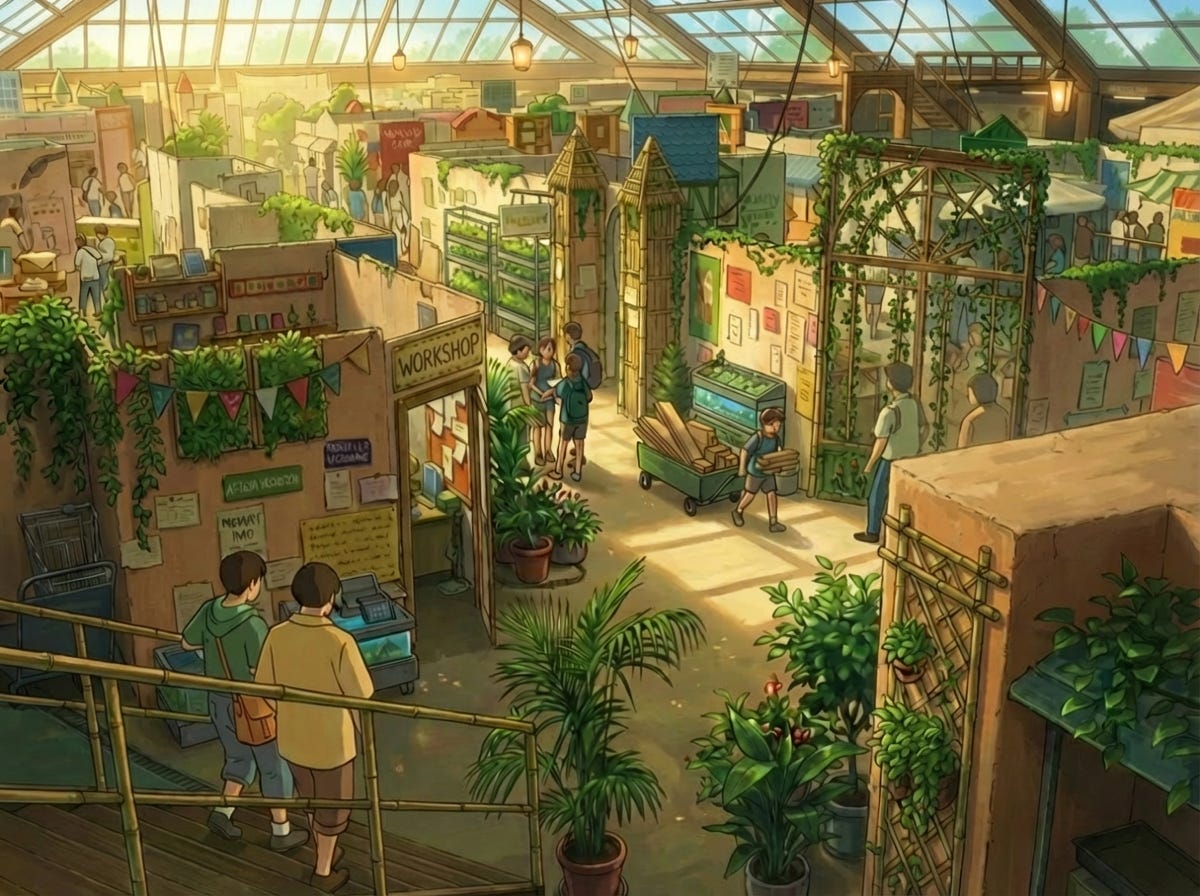
Most people in the English-speaking world have never heard of a miniature city: a temporary city run by children, with its own currency, jobs, government, stock market, newspaper, courts, and workshops. This concept goes back to 1979 when Mini-Munich was organized for the first time by a group of pedagogues as a summer program. Since then, dozens of miniature cities have sprung up across Germany and Austria, most of them running for a few weeks during the summer, none of them permanently.
But almost nothing about this tradition has been available in English. The handbook on creating your own miniature city, the essays, and practical guides written by the people who built and ran these cities, exist only in German. The result is that the concept of miniature cities, tested and refined over more than forty years, remains invisible to the English-speaking world.
minicities.org exists to change that.
What we do
We translate. The most important German-language texts on miniature cities (books, essays, institutional reports) will be translated into English. When Reinhard Kahl wrote about Mini-Munich while filming a documentary about it, or when Gerd Grüneisl and Wolfgang Zacharias published their 400-page-long account of how Mini-Munich was organized and what worked and what didn’t, no one outside the German-speaking world could read it.
We write. Original essays that analyze how miniature cities work, what makes them succeed or fail, and how they compare to other attempts at children’s education. We also encourage others to write about miniature cities in different publications, and will provide the necessary information and quotes to them. If you are interested in writing a guest post here on minicities.org, reach out. There is no shortage of angles worth exploring: miniature cities as seen through the lens of John Dewey, or Ivan Illich, or John Taylor Gatto; the historical predecessors, like the George Junior Republic; comparisons to Montessori, Sudbury, or forest schools; the economics, the governance, the architecture. We are happy to hear from educators, urbanists, researchers, parents, and anyone else with something to say.
We conduct research. This summer, we intend to conduct surveys in miniature cities to study what children actually gain from the experience. Do children who spend two or three weeks in a miniature city develop a better understanding of economic and political concepts? How do their job preferences change? From “influencer” to “architect”? Does their sense of agency, the belief that their own actions can affect the world around them, shift in measurable ways? There is abundant anecdotal evidence that miniature cities are formative. There is very little quantitative evidence. We want to start producing some.
We want to make it easier to build one. Running a miniature city is logistically demanding. It requires space, materials, skilled adult counselors, a governance structure, a currency system, and a plan for how institutions relate to one another. Much of this knowledge currently lives in the heads of a small number of experienced organizers. We are working toward practical guides, templates, and resources that reduce the friction involved in setting up a miniature city, whether temporary or permanent.
We explore what it would take to run a miniature city permanently. Every miniature city that exists today is a temporary program, a few weeks in the summer, then gone. The question of whether a miniature city can operate year-round, retaining what makes it attractive while solving the problems of funding, staffing, and the children eventually outgrowing it, is one we take seriously. If it can be done, it may be the most consequential thing a miniature city could become.
We raise and distribute funds. We will accept donations that support the work described above: translations, original research, surveys, and the development of practical resources. We also plan to re-grant funds to miniature cities around the world.
Why this matters
The premise behind miniature cities is simple and, once you see it, hard to dismiss: children are capable of far more than we let them do. Not in the abstract, motivational-poster sense, but in the concrete sense that a ten-year-old can run a newspaper on a deadline, work in a beauty salon, adjudicate disputes in a court, sit on a city council and establish and then abolish a police force when it turns out to cause more problems than it solves.
The conventional approach to preparing children for adult life is to keep them away from it. Miniature cities take the opposite approach.
This is not a new idea. It has been working, quietly, in Germany and Austria for over four decades. minicities.org intends to make it visible to everyone else.