
Mini-Munich has been partially funded by the city of Munich since 1979. What is unusual is that support for it has never been a partisan issue. Every faction in the Munich city council, from the conservative CSU to the SPD to the Greens, has publicly backed the program. They just emphasize different things. The CSU talks about individual responsibility and family access. The SPD talks about participation and social inclusion. The Greens talk about democratic education. They are all looking at the same city and finding their own values reflected in it.
This is not the normal pattern. Education projects in most countries are politically contested. Progressive educators and conservative parents rarely agree on what children should be doing, let alone how public money should be spent on it. Mini-Munich is different. Not because it is bland or inoffensive, but because it is rich enough that people across the political spectrum can look at it and find what they care about most.
What a libertarian sees. Children in Mini-Munich choose their own work. No one assigns them a job. If they dislike a job, they quit and find another one. Children who want to start a business can do so. There is a market where goods made in the workshops are sold at prices set by the sellers. There is a stock exchange. The currency is earned and spent through voluntary transactions. The entire experience is an exercise in individual agency and voluntary exchange.
What a civic republican sees. The same city has a mayor, a city council, courts, and tax collection. Children elect their representatives. They pass laws. They debate whether to establish a police force, and when they do, and it goes badly, they abolish it through a legitimate political process. The newspaper and TV station hold institutions accountable. The court adjudicates disputes.
What a progressive educator sees. There are no grades, no curricula, no standardized tests. Children learn by doing, not by sitting. A child working in the newspaper learns to write because the readers will complain if the article is incomprehensible. A child in the kitchen learns about hygiene because a snail turning up in the salad leads to a public scandal and an appearance on the evening news. Motivation is intrinsic. Feedback comes from natural consequences, not from teachers with red pens. Children of different ages work side by side, and the hierarchy is based on competence, not age.
What a conservative sees. Children in Mini-Munich take on real responsibility. They have to show up on time because the newspaper has a print deadline and the bakery has customers waiting. They handle money, fulfill contracts, deal with scarcity. The adult counselors are skilled craftspeople who can actually do glassblowing, carpentry, and basket weaving, and the children sense this competence immediately and respect it. The products made in the workshops are real and must be of sufficient quality to be sold.
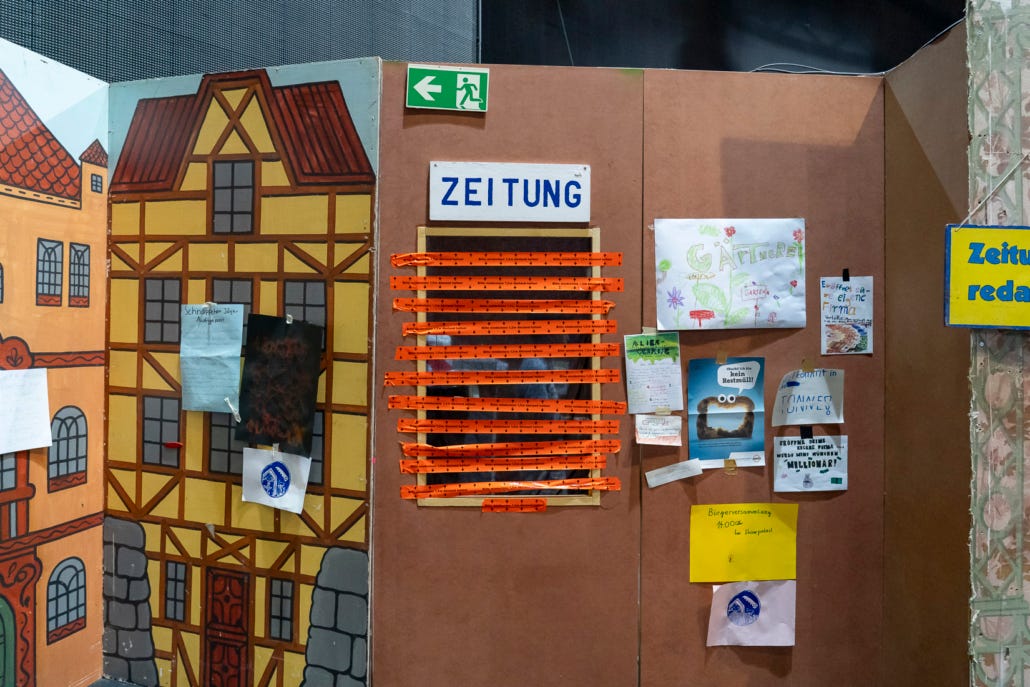
The reason Mini-Munich appeals across these lines is that it contains markets and governments, individual freedom and public institutions, craft and creativity, competition and cooperation, all at once. The parts that any given observer finds most salient say more about the observer than about the city.
The objections, where they exist, come from the extremes. From the far left, the complaint is that Mini-Munich trains children for capitalism: they earn wages, pay taxes, sell goods for profit, and learn to treat money as the medium through which the city operates. A child who spends three weeks working for a currency, saving it, and spending it in a marketplace is being socialized into an economic order that some would rather see dismantled than rehearsed. From the far right, the complaint centers not on economics but on authority: children have too much freedom, too much say in how things are run. They elect their own government, pass their own laws, and can overrule decisions made by adults. A city where ten-year-olds abolish the police force and no adult intervenes is, for some, not empowerment but anarchist disorder.
Everyone else can find something to admire. And they would all be right.